
HowMedhaArcisReshapingAutonomousRobotics& EdgeAI
A structural examination of autonomous frameworks, edge AI perception models, and sovereign field hardware deployments shaping the modern robotics landscape.
Executive Abstract
Autonomous systems and edge AI deployment have advanced past isolated laboratory pilots. Large language models, multi-modal perception stacks, and autonomous edge hardware are increasingly embedded into critical operational workflows, field intelligence pipelines, and sovereign tactical infrastructures.
MedhaArc is reshaping autonomous field adoption not by amplifying ungrounded model capability claims, but by reframing aerial autonomy and edge AI deployment as an integrated systems engineering challenge. Through sovereign hardware fabrication, deterministic RTOS flight controllers, and low-latency computer vision pipelines, MedhaArc advances a disciplined approach to physical AI operationalization.
Introduction
The adoption curve in physical AI and autonomous aerospace has entered a crucial transitional phase. The 2022–2023 surge in generic artificial intelligence sparked rapid experimentation. By 2024, enterprises and field operators found themselves burdened with fragile prototypes and fragmented proof-of-concepts.
Today, the strategic imperative is no longer whether to deploy autonomous robotics, but how to deploy them safely in unmapped, hostile, or GPS-denied environments without destabilizing compliance boundaries, safety protocols, or mission telemetry.
Within this landscape, MedhaArc's approach distinguishes itself by positioning edge AI as a foundational infrastructure layer within cyber-physical operations, rather than a brittle standalone software accessory.
Industry & Technological Background
Computer vision and edge neural networks have matured into foundational autonomous systems. Architectures derived from lightweight convolutional networks and spatial vision transformers now underpin obstacle avoidance, terrain mapping, agricultural NDVI analytics, and perimeter surveillance.
Yet the field production landscape presents formidable environmental complexity. Real-world robotics operate across dust, high thermal loads, electromagnetic interference, and variable lighting. Autonomous aerial systems must seamlessly coexist with RTK centimeter-precision positioning, localized identity protocols, and low-latency radio links.
Across agriculture, industrial audits, and tactical defense, the transition from controlled bench testing to resilient field capability represents the defining engineering milestone of the current generation.
Core Analytical Discussion
Enterprise autonomous robotics adoption relies on three structural engineering pillars: Contextualization, Containment, and Continuity.
Contextualization embeds edge neural models within tight operational boundaries. Generic vision models struggle with field aberrations. MedhaArc's approach emphasizes onboard quantized inference engines trained on specialized aerial imagery and sensor fusion rather than unconstrained cloud APIs.
Containment addresses real-world failure surfaces. Hardware payloads introduce mechanical and electronic vectors of risk: sensor drift, communication jamming, and transient actuator faults. MedhaArc integrates hardware-level watchdog layers and deterministic fail-safe triggers that enforce safe returns even under catastrophic compute failure.
Continuity governs lifecycle longevity. Environmental wear, thermal cycling, and firmware updates alter physical kinematics over time. MedhaArc embeds onboard telemetry loggers that continuously monitor motor vibrations, battery cell health, and perception confidence to ensure dependable repeatability.
Technical Architecture / Systemic Dimension
The MedhaArc architectural model is built as a vertically integrated stack rather than a loose assembly of disparate off-the-shelf parts.
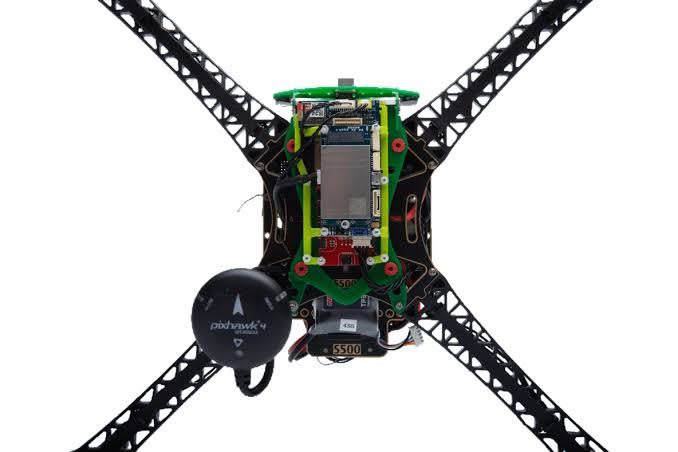
At the foundation lies sovereign hardware: custom multi-layer PCBs, isolated CAN bus lines, and carbon-fiber monocoque airframes. Above this sits the real-time deterministic flight control layer, executing low-jitter attitude adjustments with microsecond precision.
The neural perception layer operates on dedicated edge silicon (such as high-efficiency TensorRT cores) decoupled from critical motor-flight loops. Perception outputs feed into high-level guidance algorithms mediated by deterministic policy guards.
This architecture directly addresses a vital truth: AI vision models are probabilistic, whereas aerospace flight dynamics are uncompromisingly physical.
Strategic & Ecosystem Implications
The shift from experimental demos to verified autonomous field systems redefines organizational capability requirements. Enterprises must bridge aerospace mechanical engineering, embedded firmware, edge AI inference, and airspace regulatory compliance.
Vendor concentration in foreign drone hardware introduces grave supply chain and security risks. MedhaArc's sovereign manufacturing and localized R&D grant full supply chain transparency and verifiable hardware integrity.
Short-term value realization delivers labor cost reductions and accelerated inspection cycles. Long-term transformation, however, emerges from integrating aerial robotics into enterprise digital twins and spatial decision intelligence systems.
Rules & Ethics (Governance Considerations)
Civil aviation and defense authorities globally have enacted stringent airspace regulations, remote ID requirements, and strict payload auditing rules.
Autonomous systems that make real-time decisions in civilian airspace or industrial plants require auditable telemetry trails. MedhaArc implements tamper-evident flight data recording, encrypted MAVLink data links, and continuous pilot-in-the-loop overrides.
Ethically and operationally, sovereign robotic systems must prevent unauthorized payload control and uphold strict data privacy over scanned civilian topography.
Implementation & Structural Constraints
Despite rapid advances in edge computing, physical constraints persist. Battery energy density dictates payload weight, while aerodynamic drag bounds endurance.
Workforce adaptation represents another operational barrier. Pilot certification, situational awareness, and technical drone maintenance require dedicated institutional training programs.
MedhaArc overcomes these hurdles through turn-key solutions: combining ruggedized hardware, comprehensive DGCA-aligned training curricula, and structured deployment roadmaps that ensure safe, gradual adoption.
Forward Outlook & Innovation Trajectory
Over the next three to five years, aerial robotics will converge with decentralized swarms, edge 5G/satellite communications, and federated environmental learning.
Uncrewed systems will increasingly perform complex multi-agent collaborative missions—such as collaborative agricultural spraying, coordinated disaster reconnaissance, and automated perimeter interdiction—without central server bottlenecks.
MedhaArc's strategic roadmap focuses on advancing sovereign autonomous capability: establishing rock-solid platform reliability before unlocking higher tiers of autonomy.
Concluding Analysis
Autonomous robotics adoption is defined not by novelty, but by rigorous physical systems engineering. Machine learning models achieve transformative impact only when paired with sovereign hardware, deterministic safety governors, and operational reliability.
MedhaArc continues to pioneer sovereign aerial and robotics ecosystems, turning deep-tech engineering research into resilient real-world machinery.
Build Real Aerospace & Autonomous Robotics Hardware
At MedhaArc Labs, we transition students and engineering learners from passive tutorials to physical engineering. Explore our hands-on drone flight controller kits, 6-DOF robotic arm testbenches, and institutional STEAM curriculum.