AgriculturalDroneSelection: MultispectralSurveyingvs.LiquidSprayingHexacopters
A quantitative engineering breakdown comparing canopy scouting radiometers and liquid dispersal hexacopters for commercial agronomy operations.
1. The Fundamental Distinction: Scouting vs. Dispersal
A frequent misconception among agricultural enterprises and farm operators is that a single drone platform can efficiently perform both high-resolution canopy scouting and heavy chemical spraying. In reality, these two operational objectives impose diametrically opposed aerodynamic, structural, and energetic demands on an airframe.
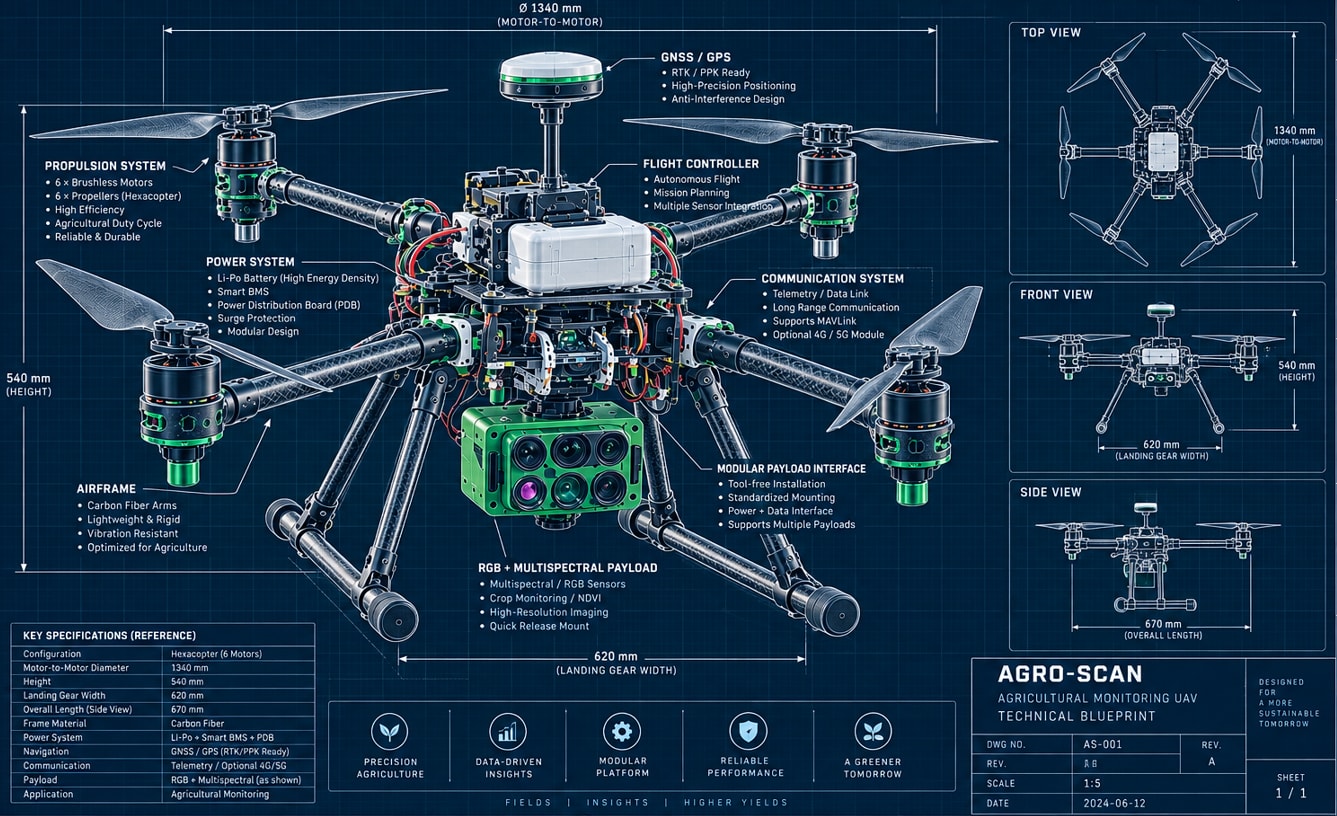
Canopy surveying demands long endurance, aerodynamic glide efficiency, and high cruise speeds at altitudes of 60m to 120m Above Ground Level (AGL) to capture hundreds of acres in a single battery cycle. The AGRO-SCAN Multispectral UAV Platform exemplifies this architecture, prioritizing low all-up-weight (8.4 kg MTOW), high-density 6S power storage, and an optical payload weighing under 800 grams to achieve 42 minutes of continuous flight.
Conversely, crop spraying demands brute low-end thrust, structural payload rigidity, and controlled propeller downwash at low altitudes (1.5m to 3.0m above canopy). The 10L 6-Axis Precision Agricultural Sprayer uses a heavy-duty 1513mm hexacopter airframe operating at up to 19.5 kg MTOW. Its six 23-inch carbon-polymer propellers are specifically sized not for aerodynamic glide, but to generate thousands of liters of downward air displacement that forces atomized liquid past upper leaves to the root stems.
2. Multispectral Scouting Mechanics & Radiometry
Standard RGB cameras capture visual light across Broad Red, Green, and Blue spectra (400nm to 700nm). However, plants exhibit their earliest physiological reactions to water stress, nitrogen deficiency, and fungal pathogens in narrow electromagnetic bands—specifically the RedEdge (705nm–740nm) and Near-Infrared (NIR, 780nm–890nm) regions.
When plant cells are healthy, mesophyll structures scatter NIR radiation while chlorophyll actively absorbs red light. Under stress, cell wall collapse causes NIR reflectance to drop sharply days before chlorosis (leaf yellowing) becomes visible to the human eye. By utilizing calibrated 5-band narrow optical filters (Blue 450nm, Green 560nm, Red 650nm, RedEdge 730nm, NIR 840nm), platforms like AGRO-SCAN compute quantitative Normalized Difference Vegetation Index (NDVI) and Normalized Difference Red Edge (NDRE) heatmaps.
Crucially, accurate vegetation indexing requires an upward-facing solar irradiance sunshine sensor. Without continuous ambient light normalization, cloud shadows or changing solar angles distort vegetative index calculations, causing artificial stress readings across sequential flight lines.
3. Heavy-Lift Spraying Aerodynamics & Downdraft Physics
Spraying effectiveness is governed by droplet size distribution and aerodynamic wake dynamics. If droplet sizes are too small (<100 microns), thermal updrafts and ambient wind drift cause chemical evaporation or off-target contamination. If droplets are too large (>400 microns), runoff occurs, wasting chemical inputs and causing soil toxicity.
A multi-rotor spraying platform overcomes this through rotor downwash. Extended spray booms position atomizing nozzles directly underneath the propeller blade tips where induced airflow velocity is highest. As the 10L Sprayer navigates crop rows at 4.0 m/s to 8.0 m/s, the downward thrust vortices push the 150–250 micron droplets through the dense canopy canopy, coating the undersides of foliage where aphids, mites, and fungal blights typically colonize.
Furthermore, modern agricultural sprayers utilize inline digital flow meters coupled with flight speed telemetry. If the drone slows down to turn at a field headland, the pump discharge rate dynamically dials back to maintain a constant liters-per-hectare application rate, preventing dangerous local chemical pooling.
5. Operational Throughput & Acreage Economics
Operational efficiency determines capital expenditure payback. Commercial growers must balance battery turnaround cycles against daily acreage goals:
6. Engineering Decision Framework: Which System Do You Need?
Choose a Multispectral Surveying Drone (AGRO-SCAN) if: Your primary operational objective is early disease identification, seed germination counting, irrigation leakage auditing, crop damage assessment for insurance, or generating precision prescription maps for third-party contractor sprayers.
Choose a Precision Spraying Hexacopter (10L Sprayer) if: You have existing knowledge of pest outbreaks or scheduled foliar nutritional cycles and require immediate, autonomous, all-weather application that avoids soil compaction and eliminates chemical exposure for ground laborers.
For enterprise agribusinesses cultivating over 500 contiguous acres, deploying a paired ecosystem—using AGRO-SCAN to pinpoint stressed zones and the 10L Sprayer to execute targeted variable-rate applications—reduces overall chemical volume by 25% to 35% compared to broadcast tractor spraying.
Build Real Aerospace & Autonomous Robotics Hardware
At MedhaArc Labs, we transition students and engineering learners from passive tutorials to physical engineering. Explore our hands-on drone flight controller kits, 6-DOF robotic arm testbenches, and institutional STEAM curriculum.