MIDASHand: WhyDexterousRobotsNeedaSenseofTouch
A robot can recognize an object with a camera and calculate how to grasp it. But what happens when the object starts slipping, a tool needs to be rotated between the fingers, or contact changes in a way that a camera cannot easily observe?
1. A Robotic Hand Designed to Feel Contact
A robot can recognize an object with a camera and calculate how to grasp it. But what happens when the object starts slipping, a tool needs to be rotated between the fingers, or contact changes in a way that a camera cannot easily observe?
These are some of the challenges that make robotic hands much harder to engineer than they first appear. The MIDAS Hand↗ project addresses them with an open-source robotic hand that combines human-like dexterity, integrated tactile sensing, and a software ecosystem designed for manipulation research. Its most interesting contribution is not simply the ability to move individual fingers, but the combination of movement, touch, and learning in one research platform.
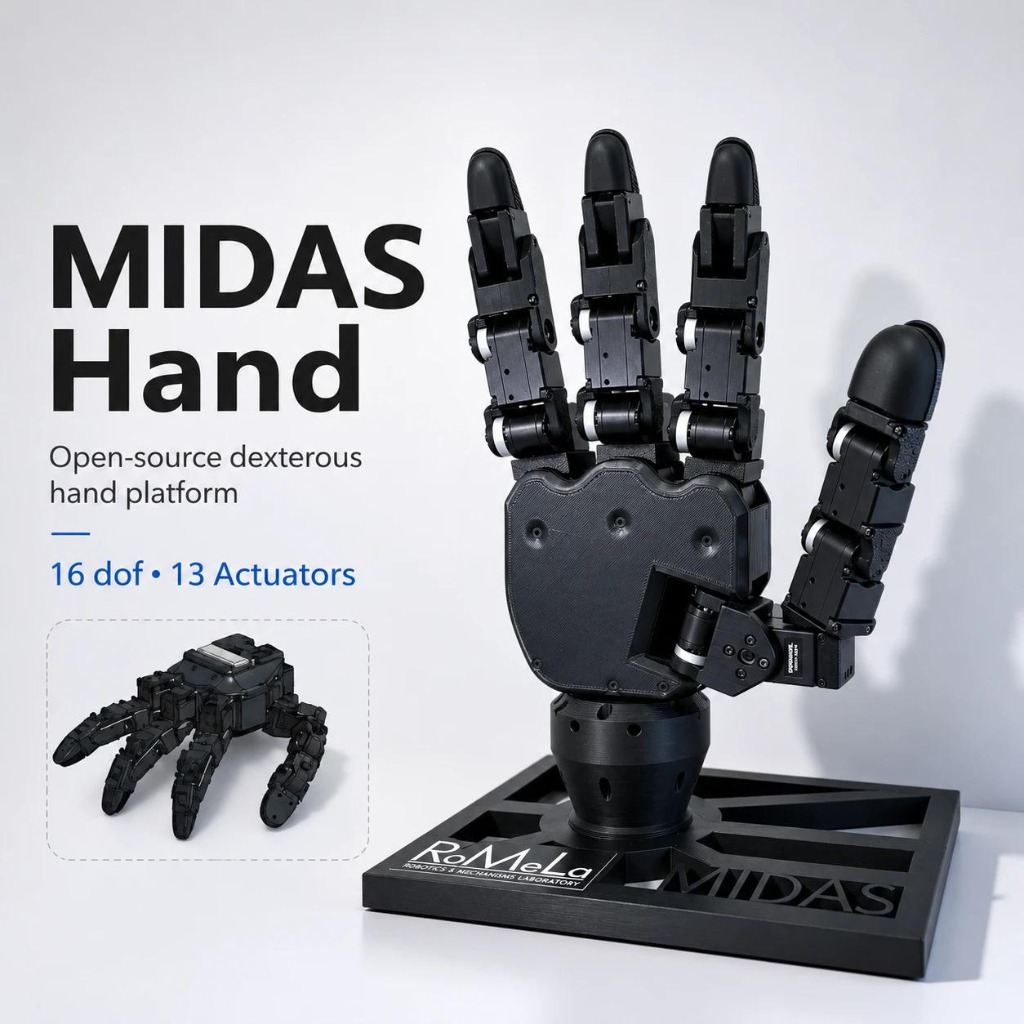
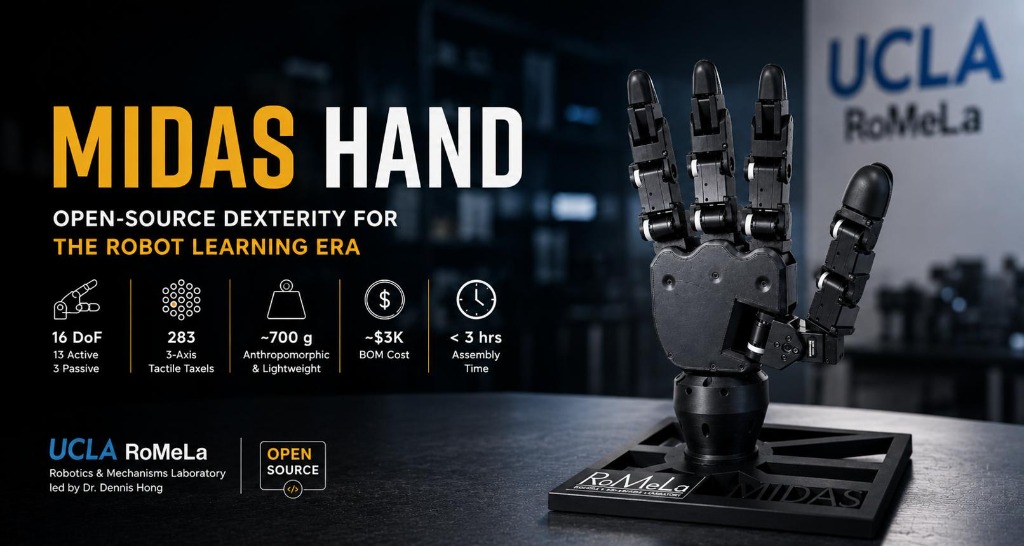
MIDAS stands for Modular low-Impedance Direct-drive Anthropomorphic Sensing Hand. Developed by a research team including Alvin Zhu, Mingzhang Zhu, Beom Jun Kim, Quanyou Wang, Jose Victor S. H. Ramos, and Dennis Hong at the UCLA Robotics & Mechanisms Laboratory (RoMeLa), the platform is intended for robot learning, teleoperation, and dexterous manipulation experiments. It is a research platform rather than a finished consumer or medical prosthesis.
Its published specifications describe a compact system with 16 degrees of freedom, 13 actively driven degrees of freedom, and 283 three-axis tactile sensing elements, weighing approximately 700 grams. The project also provides printable mechanical parts, computer-aided design files, simulation models, and control software. See the official project website↗ and research paper on arXiv↗.
Those numbers matter because dexterous manipulation requires several capabilities to work together. The fingers must move through useful ranges, the thumb must oppose them, the mechanism must tolerate physical interaction, and the system must detect what happens at the contact surface.
A hand that can reproduce a programmed pose is not necessarily a hand that can reliably manipulate an unfamiliar object. MIDAS is designed to support research into that distinction.
2. Why Direct-Drive Actuation Changes the Interaction
Many robotic hands use tendons or cables to transfer motor motion to finger joints. This arrangement can help with packaging, but friction, elasticity, and cable routing can complicate the relationship between motor commands and actual finger movement.
MIDAS instead uses directly driven joints connected through rigid mechanical linkages. Its actuators drive the joints without a tendon transmission, and the project emphasizes low backdrive torque.
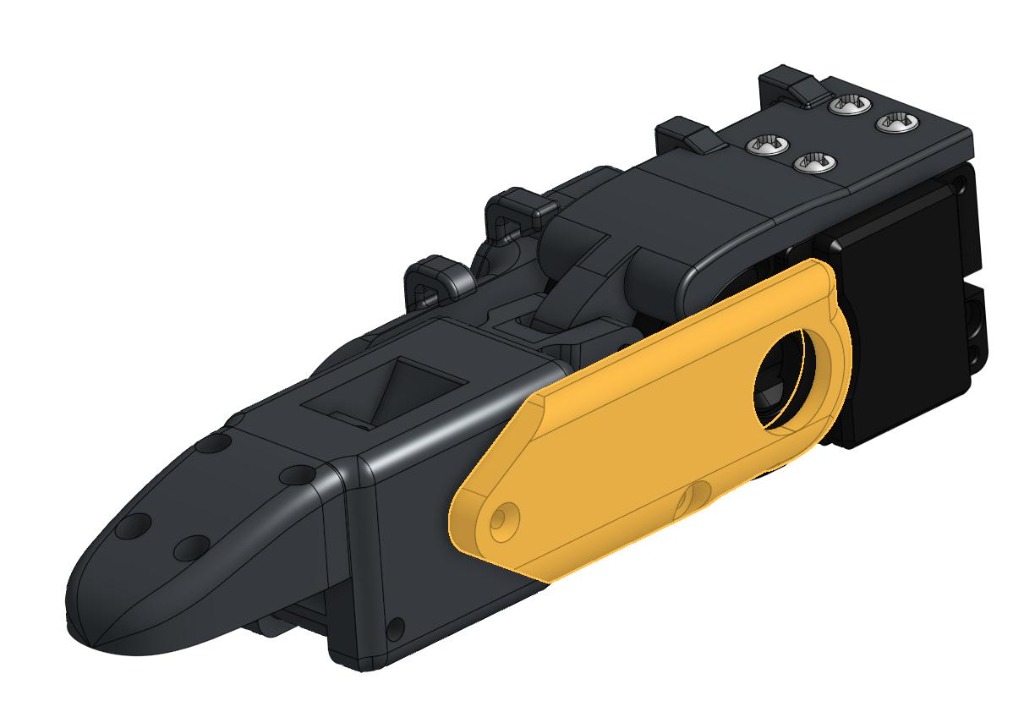
Backdrivability describes how readily an external force can move a mechanism in reverse, rather than being resisted by its motor and transmission. Consider a robot finger pressing against an object: if the object pushes back, a highly resistant mechanism may fight that movement. A more backdrivable design can yield more readily to external contact.
This matters because the robot does not always know the exact shape, position, or resistance of an object before touching it. Mechanical compliance at the interaction level can make contact easier to manage, although backdrivability alone does not guarantee safe or successful grasping.
The MIDAS Hand API↗ supports actuator communication, calibration, position commands, and tactile readout. Its documented position-control mode combines position tracking with a configurable current limit. This lets the controller constrain actuator effort rather than treating every position command as something to enforce regardless of contact.
The engineering lesson is that dexterity depends on more than the number of motors. Mechanical transmission and control strategy determine how those motors behave when the real world pushes back.
3. Touch Turns Grasping into an Information Problem
A camera can estimate where an object is, but it cannot always reveal exactly how a robot is interacting with it. Fingers may obscure the object, contact may occur at an unexpected point, or tangential forces may indicate that a grasp is becoming unstable.
MIDAS addresses this with multi-axis tactile sensing arrays mounted on the thumb and three opposing fingertips. Together, these sensors provide 283 three-axis taxels—individual sensing elements that capture local contact information, including normal and shear forces.
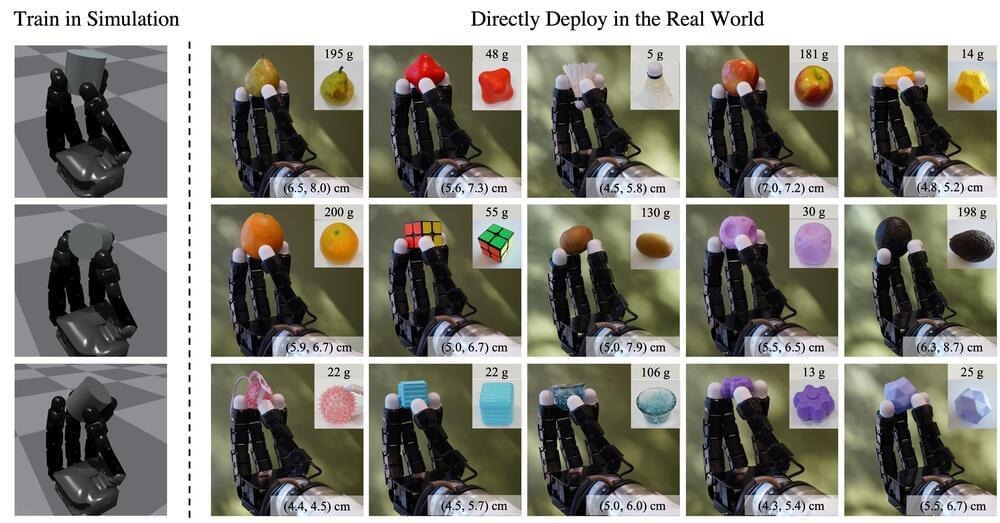
Why measure forces in multiple directions? Imagine holding a book upright. The force pressing the book against your fingers differs from the force that would make it slide downward. Detecting both kinds of force gives a robot more information about whether its grasp is stable.
That information can support slip detection, grasp monitoring, and tactile-reactive control research. However, having tactile sensors is not the same as having a complete autonomous tactile-control system. Sensors provide observations; a controller or learned policy must interpret those observations and decide how to respond.
The MIDAS project makes tactile measurements accessible through its software interface, creating a foundation for researchers to investigate that relationship between sensing and action.
4. From Human Demonstration to Robot Learning
A dexterous hand also needs a practical way to acquire useful movements. Writing commands for every joint by hand would make collecting manipulation demonstrations slow and cumbersome.
MIDAS therefore includes a software pipeline connecting human hand tracking, motion retargeting, robot control, and simulation. Its teleoperation software↗ uses webcam-based tracking with MediaPipe and data gloves, while the retargeting package↗ translates tracked human-hand geometry into joint commands appropriate for the robot.
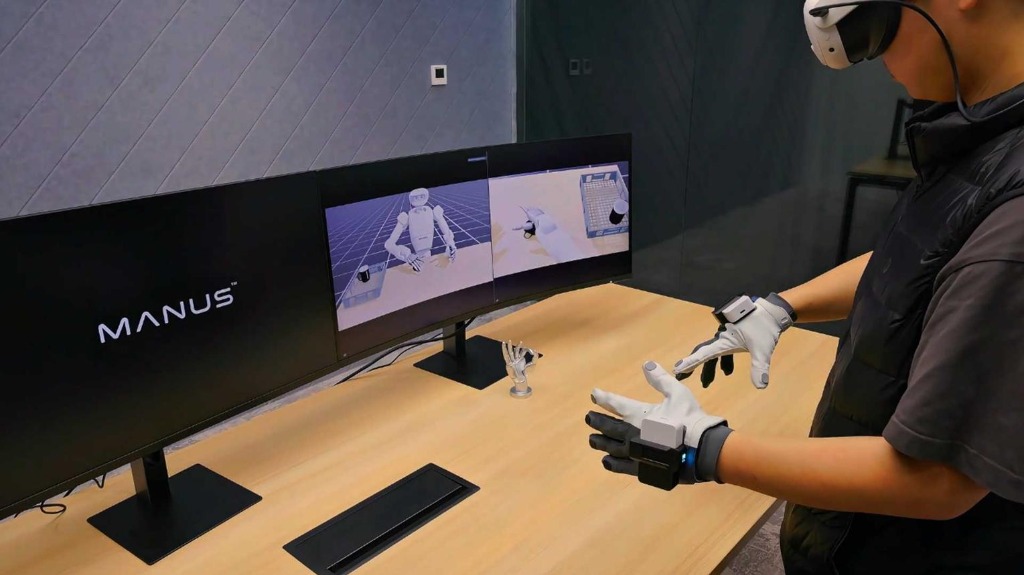
The key concept is motion retargeting. A human hand and a robotic hand do not have identical joint arrangements or movement limits. Simply copying every human joint angle would therefore be insufficient. Instead, the software must use information about the human hand's geometry to calculate a suitable robot configuration.
The project also provides models for the MuJoCo physics simulator. Researchers can inspect movement and develop simulation-based experiments alongside the physical platform. Simulation is useful, but its results still need to be checked against real hardware, where friction, contact, actuator behaviour, and mechanical variation can differ.
Together, these tools make the hand more than a mechanical device. They help turn human demonstrations and physical interactions into data that can be used to study and train manipulation systems.
5. The Engineering Insight: Build the Whole Research Loop
The central lesson from MIDAS Hand is that dexterous robotics cannot be reduced to making a hand move.
Useful manipulation requires a connected system: mechanics that permit appropriate movement, actuators that respond to commands, sensors that reveal physical contact, and software that connects those observations to control and learning.
MIDAS brings these elements together in an open-source platform, with modular 3D-printed construction and supporting simulation and teleoperation tools. The authors report experiments covering grasp types, backdrivability, tactile sensing, and repeated operation.
The platform also has boundaries. It uses four fingers rather than five, and its hardware capabilities should not be mistaken for a guarantee that a learned controller will perform every manipulation task successfully.
For students and aspiring engineers, this is a useful way to think about robotics: a successful system is not simply a collection of capable components. Its real capability emerges from how mechanics, sensing, control, and software work together.
MIDAS Hand demonstrates why giving a robot more dexterity is only part of the challenge. Giving it the information and infrastructure needed to use that dexterity is just as important.
Hardware Architecture & Actuator Specifications
The physical architecture of the MIDAS Hand emphasizes low inertia, rigid direct linkages, and dense tactile coverage. The table below outlines verified specifications from the RoMeLa publication.
| Component | Subsystem Role | Specification | Verification |
|---|---|---|---|
| Direct-Drive Joint Actuators | Low-Impedance Joint Articulation | 13 actively driven high-torque brushless actuators with low backdrive torque | ✓ Verified |
| Anthropomorphic 4-Finger Mechanism | Kinematic Grasping Structure | 16 Degrees of Freedom (13 active, 3 passive coupled joints), opposable thumb | ✓ Verified |
| 3-Axis Tactile Sensor Array | Dense Multi-Axis Force Feedback | 283 three-axis taxels across thumb and opposing fingertips (normal + shear forces) | ✓ Verified |
| Modular 3D-Printed Chassis | Lightweight Structural Hand Assembly | ~700g total weight, high-tensile engineering polymer, < 3 hours build time | ✓ Verified |
| Rigid Mechanical Linkages | Power Transmission without Tendons | Tendon-free direct drive eliminates cable elasticity, friction, and maintenance | ✓ Verified |
Software Ecosystem & Teleoperation Packages
The MIDAS project distributes modular open-source packages covering motor drivers, calibration scripts, teleoperation nodes, and kinematic retargeters.
| Path / Module | Documented Purpose | Status |
|---|---|---|
| midas_hand_api | Actuator communication, position tracking, current limits & tactile readout | ✓ Inspected |
| midas_hand_teleop | Webcam-based MediaPipe tracking and VR data-glove teleoperation pipeline | ✓ Inspected |
| midas_hand_retargeter | Human-to-robot kinematic mapping and joint coordinate optimization | ✓ Inspected |
| midas_hand_sim | MuJoCo physics simulation models, collision meshes, and URDF files | ✓ Inspected |
Operational Safety & Torque Limits
Guidelines for calibrating current limits, avoiding pinch points, and safeguarding actuators during high-load contact experimentation.
Operational Safety Notice
Configure motor current limits in the MIDAS Hand API prior to grasping stiff or fragile objects. Ensure finger joint limits are calibrated in software to prevent mechanical link jamming or over-extension during autonomous policy execution.
Official Repositories & Paper Citations
Access the official project portal, arXiv research paper, and GitHub repositories below.
https://midas-hand.com/
https://arxiv.org/abs/2607.14487
https://github.com/midas-hand-org/midas_hand_api
https://github.com/midas-hand-org/midas_hand_teleop
https://github.com/midas-hand-org/midas_hand_retargeter
Build Real Aerospace & Autonomous Robotics Hardware
At MedhaArc Labs, we transition students and engineering learners from passive tutorials to physical engineering. Explore our hands-on drone flight controller kits, 6-DOF robotic arm testbenches, and institutional STEAM curriculum.